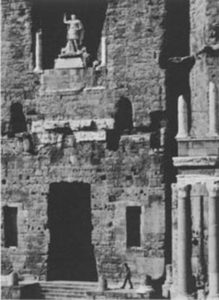
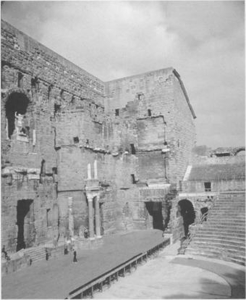
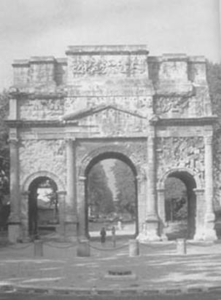
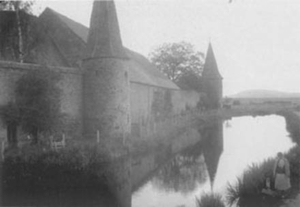
Oransch
Wolfram von Eschenbach has a gift for describing his scenes of action in a wonderfully vivid manner. The philologist Samuel Singer was struck by this and illustrated it with the following passage:
The besieging heathens march up to the castle. Their names are generally the same as in the source, except that one name Amis de Cordres, in Aliscans 1779 98:14, was turned into two: Amis und Cordeiz. These source names are supplemented by earlier ones, so that their number is greater than by Wolfram. But above all, Wolfram does not merely sum them up; each one is assigned a special position opposite one of the five gates of the castle, which he apparently visualized exactly according to the model of a town he knew: two of the gates are situated in front of the palace (Wh. 97:17): gein dem palas gelegen. The third one faces the plain (Wh. 97:28): diu uz gienc gein dem plane. The liberated Christians were ordered to defend the castle on the other side, something that is not explicitly mentioned in the source (Wh. 96:20-24):
Willehalm der kurteise, | The chivalric Willehalm entrusted
al die porte und drobe die wer | all the gates and defences above
bevalh er dem erlosten her | to the liberated Christians
daz er in dem woldean | that he had rescued in the attack
bî den soumen dort gewan. | upon the heathens with the baggage train.[1]
Thus, Wolfram von Eschenbach pays more attention to detail than does his source Aliscans and Singer assumes that Wolfram is apparently referring exactly to the model of a town he knew.
This is very likely. One feels at once invited to discover the town in the medieval geography that must have served Wolfram as his model for describing Oransch.
We know that Wolfram called himself a Bavarian, that he comes from a German town presently called Wolframs-Eschenbach in the region of Mittelfranken near Nuremberg, and that he lived for a while at the court of Hermann von Thuringia. Scattered throughout his epics Willehalm and Parzival, Wolfram mentions several towns in these regions. Next to Eschenbach: Abenberg, Truhendingen, Dollnstein, Nördlingen, Wertheim, Wildenberg and Erfurth. He also must have known Onoldsbach (Ansbach), Nuremberg, Rothenburg, Dinkelsbühl, Pleinfeld, Ellingen, Weissenburg, Merkendorf, Gunzenhausen, Kitzingen or other places. Upon scouring these areas, however, one finds not a single town that anywhere approximates Wolfram’s description of Oransch.
In attempting to reconstruct the contours of a medieval town, one soon begins to doubt whether Singer’s supposed model could ever be found. Wolfram’s Oransch is minutely described by the poet and, to be sure, very plausibly, but when looked at closer, Wolfram’s town of Oransch turns out to be a rather peculiar place indeed.
While studying the ground plan of this accurately described town, one is hard put to even consider it realistic. Wolfram’s indications seem to contradict each other. He says the town has an inner as well as an outer ring and that Giburc and her father have religious conversations there, apparently over and above an entire part of the town. This peculiarity arises when Giburc for that purpose goes to a window of her palace, while her father, who is besieging the town, is standing in a field in front of the town gate, thus outside the outer rampart. How could a conversation get started at all over such a distance?
In spite of Singer’s assumption that Wolfram is describing a very definite and familiar town, one is inclined to doubt the validity of his description and thus refer his seemingly so concrete details to the fictitious realm of poetry. One could in any case come to the conclusion that it would be better to stop trying to identify the town that Wolfram may have used as a model for describing the events in Oransch. The setting for the religious conversation is so improbable that such a scene could hardly ever be located in geographical reality.
Yet this first objection is not sufficient for refuting Singer’s assumption, for this assumption by a present-day Wolfram researcher is confirmed by an earlier and just as competent a judge.
Now, it is certainly not our intention to merely bring in the opinions of authorities or juxtapose them and – instead of judging for ourselves – believe in the authority of such experts. In this case, it is a matter of redeeming an expert from the past or having him join the discussion, an expert whose reliability is unjustly being questioned. Since Simrock’s assumption that fiction is being offered as non-fiction, the best expert on Willehalm’s material has unjustly been misrepresented by the majority of present-day Wolfram researchers. This underrated expert is none other than Wolfram von Eschenbach himself.
Wolfram assures us that in his Willehalm he is narrating a true story down to every detail. True not in the sense of poetic justice, but in the sense that the narrative matches the corresponding historical events.
In his prologue to Willehalm, Wolfram von Eschenbach tells us very clearly and with the whole moral weight of his stern personality from what exalted and ambitious viewpoint he is issuing his report. He states openly that he is not the author of his story. He relates as a matter of fact that this miraculous story comes from France and that it is true in all its details. His translation is not marred by any additions or deletions.
underswanc noch underreit | No interruption or interpolation
gevalsche dise rede nie: | ever distorted this tale.
Thus speaks a man who like no other occupied himself with Willehalm (Wh. 4:12,13).
Whoever gives any credence to Wolfram’s assurances in his prologue to Willehalm, is naïve in the eyes of a great number of Wolfram researchers. He earns a smile but is not taken seriously; more than 100 years of philological research seem to have passed him by without a trace. Three or four generations of research have indeed invested an inconceivable amount of intelligence in critically examining Wolfram’s assurances, yet they have not succeeded in proving Wolfram’s references to be either true or false.
With respect to Parzival, Wolfram bases himself on a source, an informant named Kyot. Nobody believes him. Kyot adherents and sceptics are opposed like two religious confessions. Unfortunately, historians have been unable to help either, because there are no historical documents extant with which the truth of Wolfram’s claims can be proven. Hence, it is believed that Parzival is not based on any historical fact. Our historical knowledge is also fragmentary with respect to Wolfram’s Willehalm. It is true, Loys = Louis the Pious and Willehalm = William of Orange are recognized as historical personalities, but in the absence of corresponding historical documents, no value judgment can be made regarding Wolfram’s account.
In this unpromising situation, philology has resorted to a measure with which the solution to this problem can be averted. The viewpoint has been taken that in the field of poetry every conceivable linkage of motives is possible. It is said that Wolfram does not override poetic principles in presenting us fiction as truth. From a philological point of view, it is not a question at all whether Kyot existed or not, and whether the French told the truth with respect to Willehalm.
Since sidestepping the problem, philology has on the whole been concerned with more formalistic research into Wolfram’s work. Those philologists who out of their general scientific background are still posing questions no longer considered to be philologically correct, are not taken seriously in professional circles. There are therefore less and less researchers with questions concerning Kyot. As the Kyot problem was sidetracked – philologists call it sublimation – this issue has not received the treatment desirable from a historical as well as a philological viewpoint. With every specialist, historian as well as philologist, shut up in his professional field and striking problems from his program that can only be mastered in concert with other faculties, essential questions will remain unanswered.
We would like to offer a solution to the Kyot problem by assuming a non-specialist viewpoint and invite, next to the philologist and the historian, also a geographer to join our research team.
As historical means of comparison are missing and as, philologically speaking, there seem to be no problems left, we have come to assess Wolfram’s references in a new manner. We will first examine the truthfulness of his geographic references by asking, in the first instance, whether Wolfram’s scenes of action of the Willehalm plot can be located geographically.
Singer’s assumption that Wolfram describes realities should prompt us to try to find the scenes of action in the geographical reality with the working hypothesis that Wolfram’s descriptions are true. We will not question his claim to be telling the truth, because we are making an experiment: we want to see what results from the consciously adopted viewpoint that instead of wanting to mislead us, Wolfram is relating true events.
Kyot opponents and Kyot followers agree on one point. Both of them equally admire Wolfram von Eschenbach as the greatest of Middle High German poets. Both place him alongside Goethe and rightly so. But we do injustice to these two cultural heroes by only admiring their art of poetry and not attempting to understand them in a field where they designated themselves superior to others. After all, Goethe did not care much about his poetry. What mattered to him was his colour theory. Neither did Wolfram appreciate his art of poetry all that much. But he was convinced to be greater than others, because it was granted to him to examine the truthfulness of the story he heard about. He admits that he can neither read nor write. He speaks, however, of a gift for conveying the truth as an art that is due to God’s righteousness. What he says about Kyot also applies to him (Wh. 2:16,17):
der rehten schrift dôn unde wort | Thy spirit has informed the sound
dîn geist hât gesterket | and the words of Holy Scriptures
Separating truth from falsehood is the proper task of the historical researcher. Wolfram characterizes himself as a historian through his aspirations to tell the truth. He is proud of being in a better position than others to tell what is true or false regarding the French tradition of Chrétien de Troyes.
Just as we are discovering Goethe anew today as a natural scientist without therefore appreciating him any less as a poet, we should also decide to recognize Wolfram von Eschenbach as a historian without lessening his stature as a poet. Wolfram himself is no less critical than a present-day researcher. He struggled to find the truth of Willehalm’s life and is convinced to have succeeded in recognizing this truth and in conveying it without falsehood.
Our task must be to examine his research results with our present means of research and, should they prove to be airtight, to acknowledge them.
Access to Wolfram’s frame of mind could be found by immersing ourselves in an unbiased way in his thoughts and then observing what insights we can gain thereby.
Our working hypothesis is to take Wolfram seriously, to deal with his accounts as historical facts, to first understand his references and then to linger with all the details until they no longer contain any contradictions. Should this experiment not succeed immediately, we have to ask ourselves what we did wrong and look for other points of view until everything fits in without fail and is mutually supporting.
In this sense we now want to examine what we did wrong in supposing that no religious conversation could have been held over a distance of two Oransch town walls. Assuming a positive attitude we ask: Wolfram reports that Giburc and Terramer held a religious conversation. What must the locality, the setting for this scene, therefore be like in order for Wolfram’s references to be right?
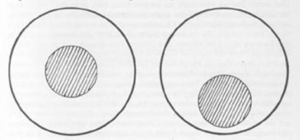
Position of the Inner City in the Outer Ring Figure 1. Concentric – Figure 2. Eccentric
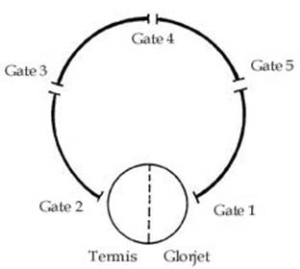
outer ring in between (Figure 2).
It is certain that the inner and outer ring of Oransch may not be represented as concentric circles (Figure 1). The outer ring would then be a hindrance. The inner ring must lie eccentrically and the palace from the outer ring too must be conceived as lying at the edge of the smaller ring, close enough to the wall of the outer ring so that there are no houses from the
If we imagine the palace window from which Giburc is speaking to be very high, so high that one can see the field in front of the gate above both town walls, then it could be possible to make oneself heard over such a distance. In that way, Giburc and her father could shout to each other to be heard.
Yet Wolfram does not say they shouted, but that they spoke. Concerning Giburc we read si sprach (she spoke, Wh. 215:10) and neither did Terramer raise his voice in answering. Wolfram says (Wh. 217:10-11):
daz ich sölh kint ie gewann, | that I ever had such a child,
sprach Terramêr der rîche. | said the mighty Terramer.
True to our working hypothesis – to give Wolfram credence – we must bring Terramer and Giburc a little bit closer together.
The special position of the inner town of Oransch in the outer ring must be conceived as being much more extreme than we have represented it until now. This eccentric position can be recognized in the passage describing how the heathens were deployed. Singer’s quotation reads that two gates are situated gein dem palas (near the palace). This is indeed more or less the case, but Singer’s representation is not yet precise enough to satisfy Wolfram’s requirements. According to Wolfram, one gate was situated (Wh. 97:17 ff.):
…..gein dem palas | …. near the palace
dâ Gyburc selbe ûffe was. | where Giburc herself was.
The second gate was also situated on the inner ring, not where Giburc was looking out on, but on the opposite side of the inner ring, which Giburc could not see while speaking from Glorjet Palace with her father. Since both city gates do not open onto the inner but onto the outer ring, and since Giburc’s palace window – in the inner ring – is situated right above Terramer’s army camp, the inner ring must extend at this place beyond the periphery of the outer ring. When we conceive of the outer ring as a circle and imagine a smaller circle, with its centre on this circle, extending half into the larger circle and half beyond it, we then approximate the situation we need in order to find Wolfram’s references confirmed (Figure 3). The wall of the outer ring now runs at a right angle into the wall of the inner ring. This inner ring is, as it were, swallowed by the wall of the outer ring. The inner ring extends at this point beyond the outer one.

Figure 4. Landscape with a Plain , Valley, River and Mountain
Assuming that the wall of Giburc’s palace was an integral part of the inner as well as the outer town wall, then her palace has some windows still situated in the inner ring above the alley leading to the gate; it has perhaps a window directly above the wall and the gate of the outer ring, and it has at least one window outside the outer ring above the ditch or above the plain in front of the city gate where Terramer has deployed his army. When Giburc goes to this window, Terramer can come directly beneath her window when he wants to speak with her. This matches Wolfram’s description of the situation precisely (Wh. 97:17 ff.):
Terramêr und rois Tybalt | Terramer and King Tybalt
sich schône leiten mit gewalt | deployed their whole army
für die porten gein dem palas | in front of the gates near the palace
dâ Gyburc selbe ûffe was | where Giburc herself was.
When we now follow the deployment of the heathens further, we learn that Phereiz and Korsant andersîte lâgen (were deployed on the other side). There is therefore a second gate in Oransch on the other side of the inner ring, where the situation is like a mirror image. We will see later that Willehalm’s palace Thermis is located there. This palace too has windows looking out directly onto the army camps of Poheiriz and Korsant.
The third gate, which is being besieged by King Margot Pozzidant, looks out – so Wolfram tells us – on the plain. The location of the fourth gate is thought to be, because no topographical details are given, opposite Giburc’s palace, beyond the outer city furthest away from the outer town wall. This gate was delegated to Fabors (Wh. 98:5). The fifth gate, where Halzebier is deployed, is to be found opposite the third gate on the right side of the outer town wall.
This ground plan of Oransch derived from Wolfram’s description shows a townscape, which apparently does not lie on a plain. When the contours of the land do not dictate something else, an outer ring is usually built concentrically around the inner castle. We should therefore ask what sort of landscape there could be that matches Wolfram’s townscape in a realistic way. Wolfram indicates something typical: the third gate leads onto a plain. He also says that Terramer wanted to attack the town from all sides, from the mountain and the valley (Wh. 111:6). We thus have to reckon with a plain, a mountain and a valley.
There are two possible ways of explaining the eccentric position of the inner ring in connection with these topographical elements: either this inner part of the town lies on or against a mountain, or it is surrounded by water and lies on a semi-peninsula. We could assume a semi- peninsula formed by a navigable river as a special protection for the inner ring. If the river is small, we could also consider a semi-peninsula-like terrace with a steep edge as such a protection. However, this semi-peninsula position would hardly be conceivable without reference to a bridge or a ford. And Wolfram mentions no such passage, not even a river of sorts.